Book Review: The Innovator’s Dilemma: When New Technologies Cause Great Firms to Fail
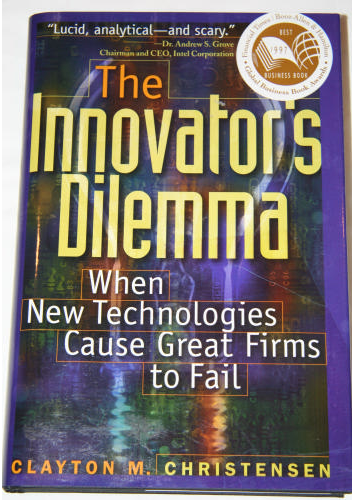 As an entrepreneur one of the biggest challenges is competing against large established corporations, because they possess more resources, capital, and have an established market segment. However, one way of entering into the marketplace is by identifying non-existing value networks by creating a disruptive technology. A disruptive technology is a new method or process of handling an existing technology, its birth often creates a new market or value network.
In his book, The Innovator’s Dilemma: When New Technologies Cause Great Firms to Fail, Clayton M. Christensen illustrates how disruptive technologies have emerged primarily via startups, and how large firms despite having good leadership and capable individuals are unable to successfully compete. He uses several industries as case studies to prove his theory: hard disks, personal computers, and mechanical excavators.
I thought this was a good read for those who are in large companies and trying to compete against start-ups or entrepreneurs who are trying to tackle a well-established product or market. Here are some takeaways from the book:
Great Firms Fail – failure of great firms in emerging technologies isn’t due to mismanagement, it is because the customer base is very different from its existing one e.g. 3.5 and 2.5 Hard Disk Drives targeted the emerging personal computer market, whereas the existing hard disk market was focused on mainframes.
Value Networks – pursing a new value network requires time and resources to understand the new value network, which established firms cannot do because it takes away from resources of current value network.
Disruptive Technology – new firms enter into markets and understand the value network, position themselves to the usage of this new technology and make it hard for established firms to enter.
Match the size of the Organization to the size of the market – Large companies pursue large opportunities, if the payout isn’t as great, they will not pursue it. Because emerging markets are small they aren’t as attractive to large firms that are looking for large revenue opportunities. It is also easier for growing companies to justify investment in new products and technologies than established
First Mover vs. Second: in disruptive technologies first mover has better advantage. Second mover trades market risk involved in entering an emerging market because the disruptive techology might not take off, for a competitive risk the risk of entering against established competition.
How Large Companies try to Compete: Large companies could tackle disruptive technologies but not at the cost of taking away resources from existing revenue generating technologies. Usually they set up independent teams to pursue the new disruptive technology, and keep the management scheme autonomous from the parent company. Otherwise the thinking of the main company and product permeates and detracts from the innovation of the new technology, which requires a different approach. Some organizations acquire smaller companies who have proven success in disruptive technologies, but often times the company that is bought doesn’t continue to succeed because of parent company’s influence and mindset. Large companies should continue to improve upon conventional technologies and be followers in adopting new ones. The dilemma is in the case of disruptive technologies being a follower is detrimental – but it is hard to allocate resources if the market size is small and returns don’t match organization size. Being small and independent is more advantageous – market size is small and more capable of understanding needs of the customers.
“Projects make sense to people if they address the needs of important customers, if they positively impact the organization’s needs for profit and growth, and if participating in the project enhances the career opportunities of talented employees.”
“…start-ups which propose to commercialize a breakthrough technology that is essentially sustaining in character have a far lower likelihood of success than start-ups whose vision is to use proven technology to disrupt an established industry with something that is simpler, more reliable, and more convenient. The established firms in an industry have every incentive to catch up with a supposed sustaining technological breaththrough while they have strong disincentives to pursue disruptive initiatives.”
Capabilities and Disabilities: each organization has processes and values that enable it to succeed. However, these same processes or capabilities often stand in the way of its success against new markets resulting in disabilities. It is hard to change these processes once they are established because they will start to hinder the organization’s progress in existing markets ultimately impacting is existing revenue base. Hence it is often times easier for a start-up or independent entity to advance, because they can setup new processes and an organizational structure that can tackle the new technology.


