
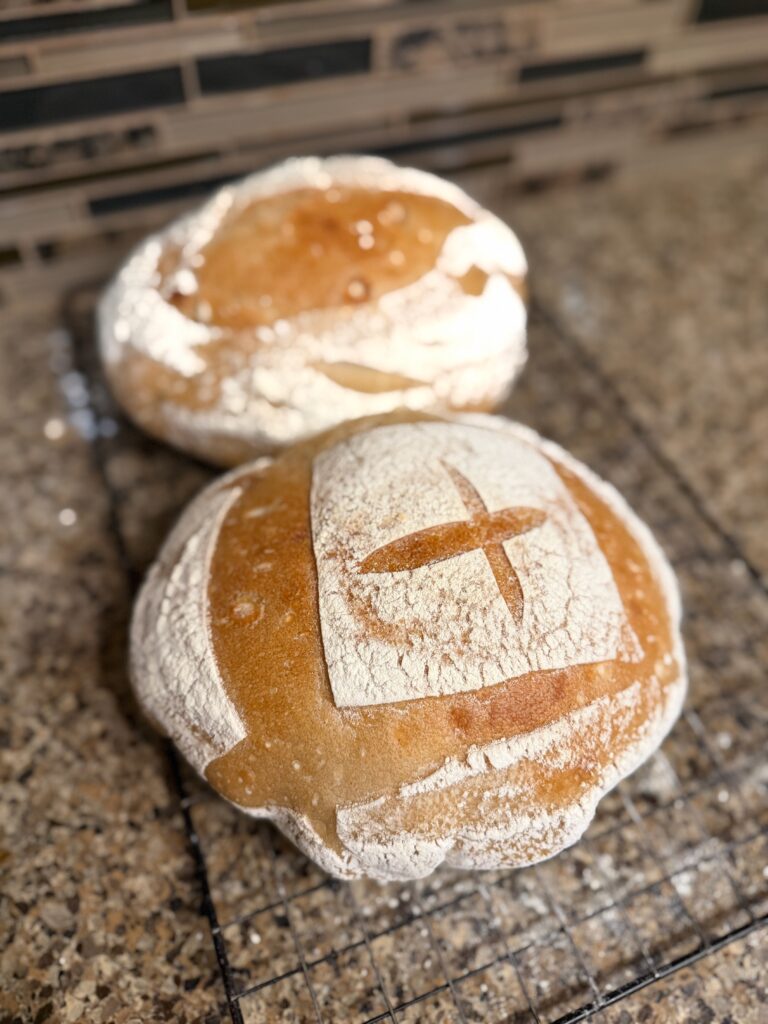
In the age of AI, the instinct is to build something new to prove your value. But the smarter move is to showcase your expertise—the work you’ve already done. Let me start in my kitchen.
I’ve been baking for as long as I can remember—but sourdough I only picked up around the time my third baby arrived. I made real progress that first year, then the next two got away from me; I just didn’t have the bandwidth to keep a starter alive. Lately, though, I’m home more, my kids have turned into enthusiastic eaters, and they’ve started requesting bread. So for the past few months I’ve been honing my practice and reaching for harder recipes.
This past weekend I attempted one called “My Best Sourdough,” from Maurizio Leo—who, fittingly, is a software engineer turned baker. It’s a 20+ hour, high-hydration recipe. A year or two ago it would have intimidated me. This time I just executed—and got a few thumbs up from the whole family. 😉
I’m opening with bread on purpose, because my kitchen has quietly been teaching me the same lesson I keep giving people about their careers. Which brings me to two questions I keep getting lately: “Should I learn X?” And: “Should I build a side project to show a future employer?” Everyone’s scrambling to create something new.
And I get it—new is shiny. It’s fun. It gives you a little dopamine hit. But here’s what I keep telling people: the real value isn’t in building something new. It’s in showcasing what you’ve already done—especially now.
In the age of AI, spinning up a project or picking up a new tool is easier than ever. So “I built a new thing” isn’t the differentiator it once was. The judgment you’ve earned and the problems you’ve already solved are.
Take your work out of the mental trash bin
Maybe you don’t think your past work is worth talking about. Maybe someone didn’t give you credit for it, demeaned it, or had you pour weeks into something only to say they didn’t need it after all. But their decision doesn’t determine whether the work—or what you learned from it—still has value.
Take that project out of the mental trash bin and look at it again. Was it actually bad—or was it a first iteration? Was it the wrong audience or the wrong timing? Did it need more polish? And does it fit into a bigger pattern of what you’ve been doing all along?
Take that work out of the mental trash bin and look at it again.
Because here’s what I almost never hear from people in the middle of a transition—a job search, a career pivot, a move to a new team: “I did X. How do I showcase it?” Or: “I’ve been doing Y. What does that tell me about my expertise?”
If you’ve been working for five or ten years, you’ve built up real expertise that’s worth showing. And if you’re earlier in your career, you have more than you think.
The Inventory Method: find the expertise you already have
Take stock of every project you’ve worked on in the last 3–12 months. Look for the recurring problems you solved, the decisions you made, and the lessons you learned. Those patterns reveal your expertise.
And here’s what the Inventory Method can help you see: something that looks like a brand-new project is often the latest expression of knowledge you’ve been accumulating for years. Let me show you what that looks like—with something completely outside of work.
A demonstration: my sourdough experiments
You saw the loaf. Here’s the part that actually matters—how I got there. When I came back to sourdough after that two-year gap, I failed at first: flat loaves, a starter I kept killing, and no time to figure out why. Over the last six months I finally had room to dig in and pin down the variables:
- Starter health—consistent feeding matters, especially early on.
- Dough rise—hydration and temperature affect both the dough and the starter.
- Timing—over- and under-proofing can ruin an otherwise good loaf.
Once I understood those, I could take on a recipe like Maurizio’s 20-hour, high-hydration bake—and actually pull it off. Each iteration built on the last.
Then life got busy again
My kids didn’t stop at country loaves—they started asking for brioche, which can run 28 hours. How was I supposed to schedule that around a weekend with three kids? So I built a little app to plan each step around when I’m actually available.
Using Claude, I turned the idea into a working MVP in roughly four active hours. It can import recipes from photos—including handwritten ones—and schedule each step of the bake.
That may look like a new project. But the thinking behind it isn’t new at all. At Mint, I worked with metrics like response time, throughput, and load balancing—back when you had to build much of that yourself. At Apple, working on the iPhone taught me how much temperature management matters and how changes ripple across an entire system.
Now I’m applying that same telemetry-and-metrics thinking to bread: how ambient temperature affects the dough, how hydration should change, when each step should begin, and which variables matter most. The domain changed. The habit of identifying variables, measuring their effects, and improving the system didn’t.
Next steps: give people a roadmap
Here’s a move I love—and it’s a communication lesson in itself: give people a roadmap, then ask them what’s worth committing to. It shows you’re thinking ahead, and it hands them the decision. So if a boss asked me “what’s next?”, here’s what I’d say:
- Monetization—tested around how many recipes a user saves.
- Alerts and reminders—nudge you when a step in the bake is due.
- More telemetry—pull in the current temperature in your home, so the schedule adjusts to your actual kitchen instead of an assumed room temp.
What looks new usually isn’t
My first iteration of this app-building process was published just a month ago. This time, I was faster—because I wasn’t starting over. I was building on what I already knew.
The sourdough followed the same pattern. So did the app. Each attempt created knowledge that made the next attempt better. That’s the real goal: make your knowledge compound so every project makes the next one faster and better.
And by sharing this process with you, I’m doing the very thing I’ve been describing: demonstrating my learning and expertise—in baking and in building software. 😉
It might look new. It’s really me building on what I already knew.
The takeaway: showcase your expertise, learn just in time
AI can help nearly anyone make something new. What differentiates you is the judgment you bring to it—and that judgment was built through everything you did before.
So, should you learn X? Yes—but learn it just in time, when you have the room and a reason to apply it, rather than in a panic. I wrote more about that in just-in-time learning.
And before you rush to build a side project, take inventory of what you’ve already built. This week, pull one project out of your mental trash bin and give it another look. What problem did you solve? What decisions did you make? What did the experience teach you? And where else have those same patterns appeared in your work?
When you start digging, you’ll realize you know a lot more than you thought—so grab your (metaphorical) shovel and start mining for your own mental gold.
If you’d like help doing exactly that, the Inventory Method is Lesson 1 of a free three-part series I created to help you extract and communicate the expertise you already have. Grab all three lessons here.
And if you want to go further, that’s what the Confident Communicator Course is for—six weeks of live practice and real feedback. The fall cohort begins Friday, October 9, with registration open through September 25.


